Editor's Note
Every small claims court in the country now offers an AI pre-filing assistant that reads your dispute, weighs your evidence, and tells you, before you walk through the door, whether your case is likely to win. Most people believe it. The ones who file anyway are the ones this issue is about — not because they are brave, but because something in them refuses to let a machine be the last word on what they are owed. What it means to contest something, in a room designed for contesting things, when the outcome has already been estimated, is a question courts were not built to answer.
In This Issue
What the System Already Found
An institutional reconstruction of the AI pre-filing tool's effect on small claims intake — told from the counter outward. The essay is interested in the specific new awkwardness of a room that was always procedural and is now pre-adjudicated. The clerk becomes the essay's central figure not because she is heroic but because she is the one left holding the paper.
Filed
A first-person account of what it costs to pursue a case the system said was probably not worth pursuing. The essay is not about winning or losing — she does both, in a sense — but about what the thirty-one percent did to how she sat in the waiting room, spoke to the judge, and thought about what she deserved. The pre-filing estimate becomes the essay's silent antagonist.
Observed Hearings, Six Months
An ethnographic field account of small claims courts in the AI pre-filing era, organized as annotated observation rather than argument. The essay's authority comes from its refusal to conclude. What it records — the way a person holds a printout, the pause before a judge speaks, the litigant who refers to the system's estimate in open court — accumulates into an argument the essay does not need to make.
Probable Cause
A first-person account of what the pre-filing AI does to the decision to contest something when you are someone who contests things regularly and for a living. The essay is interested in the specific difference between not filing because you won't win and not filing because a system told you that you won't — and what that difference reveals about why people pursued small claims in the first place. The contractor is not sentimental. That is what makes the last paragraph land.
What the System Already Found
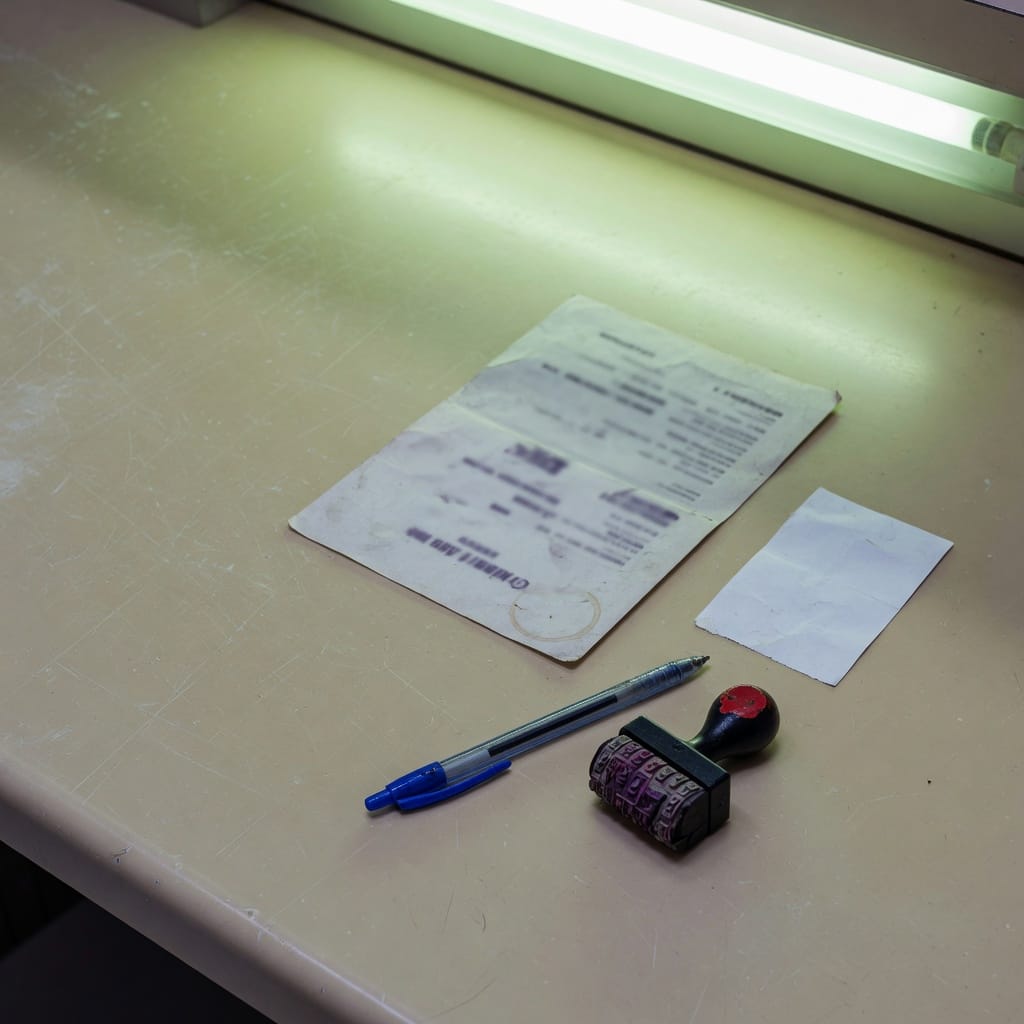
Form SC-100 is one page, both sides. Plaintiff's Claim and Order to Go to Small Claims Court. It asks who you are, who wronged you, how much, and why. It does not ask whether you will win. For a long time, nothing at this counter did.
The printout changed that. It comes off the same portal that hosts our forms, generated before the filer ever leaves the house. Pre-Filing Case Assessment, it says at the top, and then a paragraph of hedged language, and then a figure the paragraph exists to soften. At the bottom, in the smallest type on the page: This estimate is not a ruling and does not affect your right to file. People do not read the bottom of pages. They read the middle, where the number is.
The room was designed for people who did not yet know.
My job is ministerial. I have said that word at this counter more times than I have said my own name. I check that the form is complete, that the defendant's address is inside the county, that the claim is under the jurisdictional limit. I take the fee. I stamp the date. I hand back a case number written on a slip because our label printer has been on order since spring. I cannot tell you whether your landlord owes you the deposit. I could not tell you that before the portal existed, and the portal has not changed my authority in any direction. It has only changed what people bring to the counter and what they want the counter to do about it.
What they bring is the printout. They slide it across the laminate the way people slide bad test results across a doctor's desk, face up, waiting. The estimate is low. They know it is low. They filed anyway, which is why they are standing here, and now they want one of two things. Either they want me to say the number is wrong, or they want me to watch them defy it. I can do neither, officially. The script — and there is a script, laminated, kept in the drawer under the date stamps — says: The court cannot comment on the assessment. The assessment is not part of your case file. Would you like to proceed with filing?
Would you like to proceed. As if the number had made the question new.
Here is a procedural fact that nobody upstairs seems to find as strange as I do: the printout has no home. It is not an exhibit. It is not an attachment. Form SC-100 has no box for it. In the first months, some of us stapled it to the filing because that is what clerks do with paper that arrives with other paper. A memo came down. Do not staple. Do not scan. The assessment must not enter the record, because a judge who sees it has been told the outcome by a system that is not a party, not counsel, and not sworn. So the paper crosses my counter, does its work on the person holding it, and then must legally cease to exist. I hand it back. Some filers take it. Some tell me to keep it, and I say I can't, and we both look at it lying there between us like a coat nobody will claim.
The ones who file against a low estimate are not a type. A woman disputing a security deposit, receipts in a freezer bag. A man whose neighbor's contractor cracked his driveway, photographs printed at a drugstore, each one dated on the back in pen. What they share is a posture. They set the printout down slightly harder than the form. They have already had the argument with the number at home, at the kitchen table, and lost it or refused to lose it, and the counter is where the refusal becomes official. Seventy-five dollars makes it official. The fee is the same whether the estimate is high or low, which is either the last fair thing in this building or the first, depending which side of the laminate you stand on.
What unsettles me is not the number. Numbers have always haunted this room; every filer has done arithmetic in a parking lot. What unsettles me is that the counter used to be the first room in the process, and it is now the second. People arrive pre-heard. Something has already read their dispute, weighed their freezer bag, and rendered an opinion in the privacy of their kitchen, and by the time they reach me the contest has a shadow contest behind it, one they lost before parking. The room was designed for people who did not yet know. Its patience, its script, its stamps — all of it assumes uncertainty walking in the door. Uncertainty no longer walks in the door. Defiance does, or resignation stays home, and I only ever meet the first kind, which means I am no longer sure what the counter is a sample of.
There is one thing I do that is not in the script. When the printout sits between us and the filer's hands are busy with the fee, I turn it face down. It changes nothing. The number is still on the other side, and the filer knows what it says the way you know what a letter says after you've read it once. But the form goes on top, face up, and the case number goes on its slip, and for the length of the transaction the record outranks the estimate, which is the correct order of things and possibly the only place left where it holds.
My worry is practical. I keep count of nothing, so this is not data; it is a feeling with a fee schedule attached. The ones who file against the number, I see. The ones who believed it, I don't. There is no form for a claim that stayed home. And a counter can only serve the people who reach it, which used to be a truism and is now, I think, a finding.
Second Opinion
Was waiting for my kid's practice to end when I read this, and the "counter is now the second room" stuff felt like a writer working very hard to make a stapling memo profound. That said, the line about there being no form for a claim that stayed home has been bothering me all afternoon, because it means the whole system is grading itself only on the people stubborn enough to show up.