Editor's Note
A hardware store in Akron has been in the same family for sixty-one years. The grandson who now runs it installed an AI inventory and customer-advisory system eighteen months ago because the margins demanded it, and his grandmother, who still comes in on Tuesdays, has stopped offering advice to customers because the screen at the counter already has. This issue looks at what passes between generations inside a family business — the specific knowledge encoded in how you stack a shelf, read a hesitant buyer, or know which product a particular neighborhood actually needs — and what happens to that transmission when a system absorbs the knowledge and the elder who carried it is still standing there. The question is not whether the store runs better. It is what the store was ever for, and whether those two answers can belong to the same family.
In This Issue
What the Neighborhood Used to Ask For
A reported reconstruction of the adoption wave moving through independent retail hardware, told through distributor contracts, store-level interviews, and the specific redesign of the counter interaction. The essay's argument is not about technology but about what the counter was — a site of neighborhood knowledge-exchange — and what it becomes when the exchange is pre-completed.
Tuesdays
A four-month diary of Tuesday shifts told without interiority or announced feeling — only what happened, what was said, and what the system did or did not do. The form's restraint is the argument: the entries accumulate into something the diarist never names.
Passing It Down
A cultural and philosophical argument about transmission as the animating purpose of family business — and the specific disruption that occurs when knowledge is institutionalized before it is passed. The essay resists nostalgia and insists on the structural claim: that inheritance was not just economic but ontological, and that AI absorption of family expertise changes what it means to carry something forward.
Better
A first-person account from the person who made the decision — told not as a defense but as an honest inventory of what was gained and what the cost of that gain turned out to be. The essay's discomfort is that the narrator is right about the business and knows he may be wrong about something that doesn't have a line item.
What the Neighborhood Used to Ask For
Nobody was forced to install anything. Distributors are careful on this point, and the contracts support them. Beginning in 2024, the two largest hardline wholesalers serving independent dealers in Ohio, Indiana, and Illinois added to their standard dealer agreements what the documents call a technology alignment rider. A store running the distributor's approved inventory and customer-advisory platform qualifies for the preferred rebate schedule, priority allocation during shortages, and cooperative advertising funds. A store that declines remains a dealer in good standing at the base schedule, which for a single-store independent means margins that no longer reliably cover a second full-time counter employee. The regional dealers' association classifies the riders as voluntary incentive programs, which they are. Among member stores in Akron, Fort Wayne, and Rockford, adoption has tracked contract renewal dates more closely than anything a customer asked for.
The platforms are unremarkable to look at. An inventory module forecasts demand by store and season. A customer-advisory module, the part the vendors lead with, puts a screen at the counter. A clerk types in the customer's problem, or scans the failed part the customer has carried in a plastic bag, and the screen returns a recommended product, a quantity, and a short paragraph of reasoning. The reasoning is the selling point. Vendor materials describe it as expertise at every register, which is accurate, if expertise means the answer rather than the conversation the answer used to end.
The screen answers the first question completely, and completeness, at a counter, is a way of closing a door.
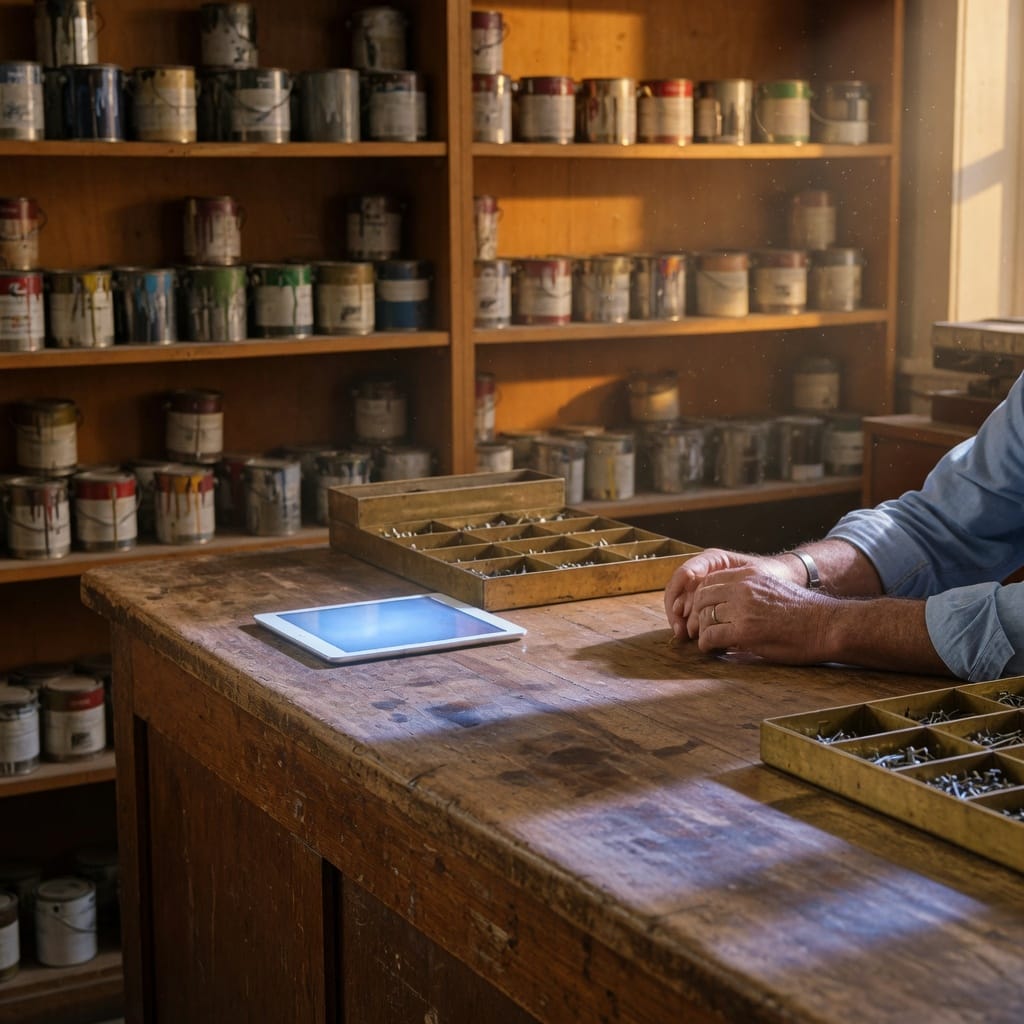
Hrabowski Hardware on Brown Street in Akron has been in the same family for sixty-one years. Dan Hrabowski, the third generation, installed the platform eighteen months ago, three weeks after his distributor's rider took effect at renewal. He does not describe the decision as a decision. His grandmother, Marie, who worked the counter from 1964 until her husband died and then kept working it, comes in on Tuesdays to face the fastener aisle and restock the bins. She has stopped offering advice to customers. Nobody asked her to stop. The screen answers before she can, and correcting it in front of a customer, she says, would look like correcting her grandson.
The counter interaction has been redesigned, though nobody at the store uses that word. The tablet is mounted facing the customer, per the vendor's installation guide, which notes that customer-visible placement increases trust in the recommendation. A man comes in with a toilet fill valve in a bag. The clerk scans it. The screen names the replacement, states the price, and explains in three sentences why it fits his tank. The exchange that used to happen — what year is the house, is the water rusty — is not prohibited. It is simply already over. A conversation that begins after its own conclusion tends to be short.
What Marie knows does not fit in the reasoning paragraph. The houses in Goodyear Heights, built for rubber workers before 1920, have wood lath and horsehair plaster, and a customer with a Goodyear Heights address should leave with toggle bolts and a warning, not the plastic drywall anchors the screen suggests because the screen has learned from what the ZIP code buys. She knows which streets in Kenmore were repiped in the eighties and which still run galvanized. The platform knows the store's sales history, which is close to the same thing and is not the same thing, because the sales history includes everything the neighborhood ever bought wrong.
The loss is not accuracy. The screen is right about the fill valve. What the old exchange carried was the second question, the one the customer almost didn't ask. A man buying caulk is usually buying caulk. Sometimes he is standing in front of a list he doesn't understand, because his mother's house is going on the market and he has never fixed anything. The old counter had delay built into it — the slow ring-up, the walk to aisle four — and the second question arrived inside the delay, when it arrived at all. The screen answers the first question completely, and completeness, at a counter, is a way of closing a door. The system does not know how to wait, because waiting was never in the requirements.
In Rockford, a counterman of thirty-one years described his job now as confirming. He agrees with the screen most of the time. When he doesn't, he has learned to disagree quietly, at the end of the aisle, out of the tablet's sightline, as though it were a private matter between him and the customer. In Fort Wayne, an owner said the advisory module paid for itself in reduced returns, and there is no reason to doubt him. The stores run better. Dead stock is down. Inventory turns faster. Every measurable function of the counter has improved, and the distributors' quarterly dealer reports say so, in tables.
Whether the counter was a function is the older question. For sixty-one years the one on Brown Street operated as something the trade press never had a classification for: the place where a neighborhood's houses were known out loud, one hesitant buyer at a time, and where that knowing passed from a woman to her son to her grandson by standing nearby. Dan never learned the plaster in Goodyear Heights. He didn't need to. His grandmother was always at the counter, and now the screen is.
On Tuesdays, Marie faces the fastener bins, wipes down the counter she has stood behind since she was nineteen, and holds sixty years of the insides of this neighborhood's walls in her hands with nowhere left to set them down.
The vendor offers an optional module its documentation calls legacy staff knowledge capture, a structured intake form a store can complete and upload. Dan intends to sit down with his grandmother and fill it out. The form has fields for product category, use case, and seasonal notes. It does not have a field for horsehair plaster by street, and it does not have a field for how long to wait, after a customer says that's all, before believing him.
Second Opinion
The toggle-bolt thing is real — my landlord's place has that crumbly old plaster and the screen anchors ripped right out. But the fix is obvious and the writer missed it: you just tell the tablet the house was built in 1918, and honestly most of us would rather do that than have some stranger behind a counter asking follow-up questions about our mom's house.