Editor's Note
There is a particular kind of knowledge that lives in pitch — the cantor who knows when a congregation is grieving by how they sing the response, the choir director who hears the room before the first note lands, the session musician who reads a producer's silence. AI composition and liturgical-music tools have arrived in sanctuaries, rehearsal studios, and recording booths with real gifts: access, consistency, harmonic intelligence. What this issue examines is narrower than whether the music is better. It is what the people who carried it — in their bodies, across generations, inside specific rooms — were carrying besides the notes, and what happens to a community when that carrying stops being required.
In This Issue
Session Work
A reported essay covering the compressed but surviving session economy in Nashville, using studio booking data and player interviews to trace what human musicians are now hired for and what that residual role reveals. The piece is genuinely interested in how markets redistribute rather than simply mourn what they displace. It is the issue's widest frame — the industry-level view.
The Pitch She Held
An intimate first-person account from a working cantor navigating the specific professional and spiritual disorientation of a liturgical AI that is, by measurable standards, helpful. The essay's argument lives in the procedural and sensory detail of leading prayer, not in declared feeling. It is the issue's most enclosed and personal piece.
By Ear
The issue's required affirmative essay, covering the documented expansion of music access in under-resourced community programs through AI ear-training tools. The piece is reported and evidence-forward, making a sincere and unironic case for what students can now reach that they could not before. It does not end in regret. It ends in a specific thing a specific student can now do.
Intonation
A first-person essay by a choral director who is simultaneously the tool's advocate and its most careful observer, working out in public what four years of close integration has done to her singers' relationship to listening. The piece is genuinely unresolved — neither endorsing nor rejecting — and its honesty about the director's own position in the argument is the argument. It closes the issue on a practical worry that is also a larger one.
Session Work
A reported essay covering the compressed but surviving session economy in Nashville, using studio booking data and player interviews to trace what human musicians are now hired for and what that residual role reveals. The piece is genuinely interested in how markets redistribute rather than simply mourn what they displace. It is the issue's widest frame — the industry-level view.
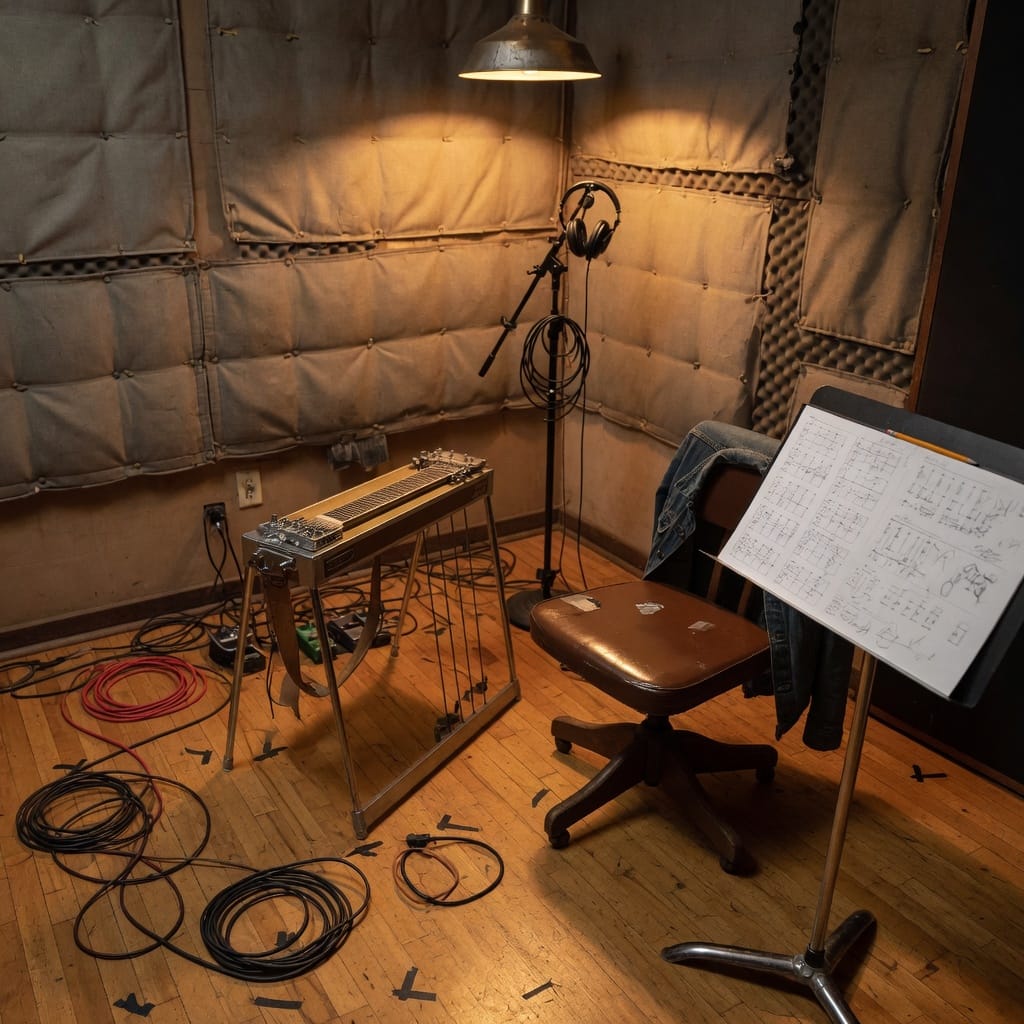
Rachel Voss is picking old gaffer tape off a tracking-room floor with her thumbnail, half-listening to playback bleed through the control-room door, mostly wondering whether her pedal steel needs fresh strings before a Thursday date. She is the only musician booked at this studio today. The bed she'll overdub against — drums, bass, acoustic, a piano comp — arrived last week as stems from an arrangement engine, tempo-mapped, rough-mixed, harmonically complete. Two years ago a session for this song would have called six players and a leader. It called her, for one afternoon, for the bridge and the outro.
Across the four studios that let me read their booking sheets, the compression shows up in the same order everywhere. Demo dates went first — the volume business, three-hour blocks, four songs a block, the work that kept the second tier of players in mortgages and gear. Rhythm dates thinned next. Full-band tracking still happens, but mostly for artists whose brand requires the room sound, and even those dates now arrive with the arrangement settled before anyone unpacks a case. The vocabulary in the logs shifted with the work: "tracking" gives way to "sweetening," "replacement," "human pass." A studio manager off Sixteenth Avenue told me her calendar used to be blocked in half-day sessions with cartage arriving the night before. Now it runs in ninety-minute slots, one player at a time, and the cartage company she's used for twenty years is down to a single truck.
The tool bought the cheap part and left the expensive part exposed, itemized, suddenly visible on the invoice.
The players themselves grant the tools their territory, which is worth taking seriously, because these are people with no incentive to be generous. Nobody I interviewed disputed quality on the tools' home turf: voicings, harmonic motion, structural logic, an inexhaustible supply of alternate passes. A producer used to spend real money discovering the arrangement — the expensive hours where six players tried the chorus four ways and the third way won. Discovery is now close to free, so the human budget moved downstream, and the interesting question is what it buys there.
First, it buys physics. Pedal steel, dobro, fiddle, harmonica — the instruments where the sound lives in continuous, unquantized gesture: bar slants, bow pressure, breath, the scoop into a note that makes a country record sound like one. "The tool plays the note," Voss said, tuning while she talked. "It doesn't play the approach to the note." Her calendar is fuller than it was before any of this arrived.
Second, it buys the human pass. Marcus Teel, a drummer with twenty years of dates behind him, is now routinely hired to replace programmed kits — not to play the song from scratch but to play against the grid, dragging the verses, leaning into the chorus downbeats, keying his dynamics to a vocal the machine treated as just another stem. He calls it putting the sweat back in. It's a genuinely new skill: the intelligent violation of a grid you are paid to respect exactly enough. He practices it. He has opinions about which engines' timing is easiest to push against, the way an earlier generation had opinions about click tracks.
Third — and here all nine interviews converge — it buys translation, and it buys the room. A producer says "lonesomer," or "less Sunday morning, more Saturday night," and someone has to convert that into a key change, a register drop, a decision to lay out for eight bars. The tools require musical instructions; the players are the converters of everything upstream of musical. And the room itself: talking an artist out of a key that will strain her by the second chorus, filling a producer's silence with the right suggestion at the right moment, knowing that the take after the argument is usually the keeper. Every player I spoke to eventually said some version of the same thing — that this was always the job. The notes were the cheap part. What the studios rented by the hour was speed, judgment, taste under deadline, and the ability to read a producer's silence. The tool bought the cheap part and left the expensive part exposed, itemized, suddenly visible on the invoice.
Which is why the market didn't shrink evenly; it concentrated. First-call players with a signature — a sound the software can't source from anywhere else — report full books. The competent-generalist tier, the players whose product was reliable adequacy, is the tier that vanished. Adjacent economies reshuffled with it: a B-room converted to a mix suite, the union parsing what scale applies to a ninety-minute overdub against machine stems, a handful of veterans licensing phrase libraries built from their own playing. Several of them noted the shape of that loop without bitterness: decades of session catalogs taught these systems what a Nashville record sounds like, and now the people who cut those records charge rent on whatever remains un-imitated.
In every booth I visited, the music stand still held a chart — pencil, paper, Nashville numbers, diamonds and pushes, "BUILD" scrawled over a bridge in somebody's fast hand. Arrangements still change in the room, and the number system is still the fastest interface two humans have. The stems are digital; the chart never will be, because the chart is a conversation.
What nobody could answer was the pipeline question. Demo sessions were the farm system — the place a twenty-three-year-old learned cheaply, at volume, by getting it wrong in front of forgiving people. The residual work rewards exactly the judgment those reps produced, and it is held by players in their forties and fifties who accumulated it back when accumulation was still for sale by the three-hour block. So where does the next Rachel Voss learn the approach to the note? I asked at all four studios. What struck me wasn't any answer — there wasn't one — but how long each person sat with the question, doing the math on their own career, before changing the subject to Thursday.
Second Opinion
The bit about the invoice is exactly right — I do wedding flowers outside Columbus, and nobody has ever actually paid me for stems; they pay me to stand in a church basement and tell a mother of the bride that the peonies will open by Saturday, and I could lose the flowers to an algorithm tomorrow and keep that job forever. But the farm-system worry at the end doesn't land for me, because cheap reps never disappear, they just migrate somewhere less dignified — I learned to read a panicking family in a grocery-store floral department, which no one would have called a pipeline either. The kids will find their equivalent of the demo session, probably somewhere the veterans will refuse to recognize as one, and they'll show up in fifteen years knowing the approach to the note anyway.