Editor's Note
In county offices, permit desks, and municipal waiting rooms across the country, a new layer has quietly arrived: AI workflow systems that pre-classify requests, route cases, and determine eligibility before a human clerk has opened the file. The people who work those desks spent years learning to read the room — to catch the thing the form didn't ask, to know when a rule bent and when it didn't. Now the room has already been read. What this issue examines is not efficiency or error rates but a specific professional and civic loss: when the judgment that used to live between a person and a bureaucratic outcome is moved upstream into a system, something changes about what it means to be the person on either side of the counter.
In This Issue
Before the File Is Opened
The essay opens not with nostalgia but with a taxonomy: the specific categories of variance request that the AI system handles well, adequately, and badly — and what 'badly' actually means when a family's property is involved. The writer does not argue the system is wrong. She argues it is right in a way that excludes a kind of rightness that used to exist. The final section describes the specific professional experience of sitting at a desk with a completed AI recommendation on her screen and a person in front of her who does not fit it, and having no override.
Discretion
The essay begins as a workplace comedy about bureaucratic absurdity and the specific indignity of being the only person on a floor who reads footnotes. It earns its laughs. By the midpoint it has become something else: an account of what it costs to maintain human judgment as an unofficial, uncompensated, structurally unsupported practice inside an institution that has stopped building for it. The ending does not resolve. It describes her open inbox.
Counter Hours
The piece is structured as a documentary record of a single physical space — the permit counter — across the eleven-week observation period. It catalogs what the counter used to require of the people behind it and what it requires now, without editorializing the difference. The flatness of the voice is the argument. The documentarian notices, early on, that the counter itself has not changed — same laminate surface, same frosted glass divider — and returns to that observation at the end in a way that is not symbolic and is not not symbolic.
What the Form Left Room For
The essay is built around one concrete thing: a forty-five-second pause in the naturalization interview that existed by convention rather than regulation, which experienced officers used to assess things the form was not designed to ask. The writer does not argue that her judgment was always right — she describes two cases where it wasn't. She argues that the pause was where the interview happened. The essay's final section describes the current process in detail and ends not on her but on the room: what it looks like now, with the score already on her screen, and the applicant not yet in the chair.
Before the File Is Opened
The essay opens not with nostalgia but with a taxonomy: the specific categories of variance request that the AI system handles well, adequately, and badly — and what 'badly' actually means when a family's property is involved. The writer does not argue the system is wrong. She argues it is right in a way that excludes a kind of rightness that used to exist. The final section describes the specific professional experience of sitting at a desk with a completed AI recommendation on her screen and a person in front of her who does not fit it, and having no override.
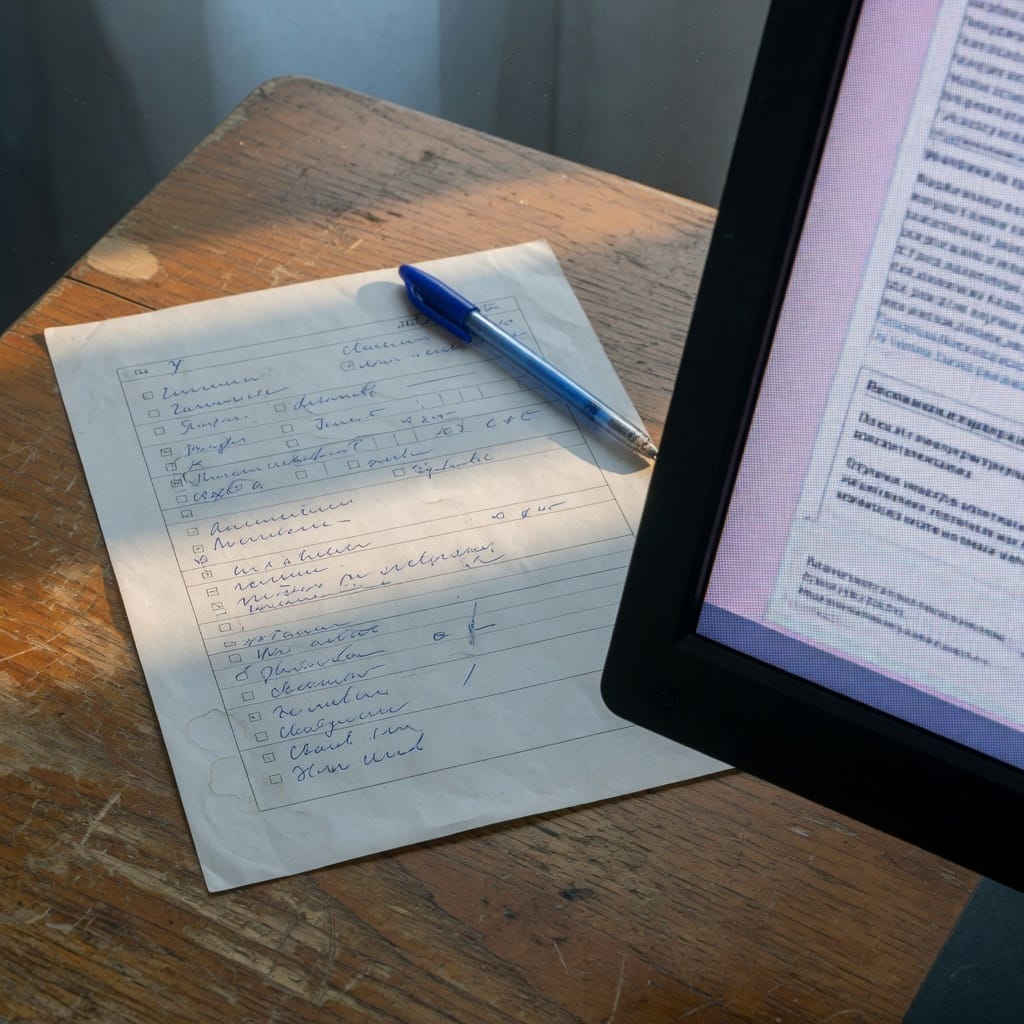
A man came to the counter once with a folder held together by a rubber band, and before he said anything he apologized for the folder. That was the tell. People who apologize for their paperwork are usually the ones who have been carrying a problem too long to explain it cleanly. He wanted a variance to keep a wheelchair ramp his son had built off the back of the house, which extended four feet past the setback line. The form didn't have a place for the son. It had a place for the four feet.
I spent nine years reading folders like that. Eighteen months ago they moved me to something called workflow oversight, which mostly means I watch a system read the folder before I do.
What was missing was never the rule. What was missing was the person who knew to reach for it.
Let me be precise about what it handles well, because pretending otherwise would waste your time. Fence height variances. Accessory structure setbacks. The homeowner who wants a garage six inches wider than the code allows. These are clean cases. A rule, a number, a distance. The system classifies them faster than I ever did and it doesn't get tired at the end of the day. On these, it is simply better than I was.
Then there is the adequate tier. Home occupation permits, minor lot-line adjustments, the cases with two or three moving parts. Here the system is fine, mostly, in the way a competent stranger is fine. It routes correctly. It flags the right code sections. If you are the applicant, you will not notice anything was lost, because for you nothing was.
Then there is the third category, and this is the one I was hired to think about, though nobody phrased it that way.
The third category is the case on the statistical edge. The application that looks, on its face, like a clear denial — insufficient hardship, self-created circumstance, the boxes that predict a no. The system reads those boxes and produces a recommendation, and the recommendation is usually right. That is the part people don't want to hear. It is usually right.
The ramp was in the third category. On paper: a self-created condition, an unpermitted structure, a setback violation. Deny. Any reasonable system would say deny, and it would be defensible, and it would survive appeal.
What the boxes could not hold was that the man's son used the ramp, that the son was the reason the house had been bought on that lot in the first place, that moving the ramp four feet meant it would clear the fence and lose the grade it needed to be usable, and that the man did not know any of this was relevant because nobody had told him the form was asking about hardship at all. He thought it was asking about the ramp. He apologized for the folder because he thought the problem was that his paperwork was messy. The problem was that the mechanism designed to hear him was a person, and that person had to be the one to ask the second question.
I used to ask the second question. That was the job. Not the form — the second question. Why did you build it there. Who is it for. What happens if you move it. Half the time the answer was nothing; the case was exactly what it looked like. But the other half, the case reorganized itself in front of me, and the same set of facts became a different application, one that the code actually had a provision for, one that a board could grant without bending anything. The variance for practical difficulty was already in the ordinance. It always had been. What was missing was never the rule. What was missing was the person who knew to reach for it.
Here is the structural claim, and I have tried to make it smaller and I can't. The system did not remove a bad process and install a good one. It removed a slow, uneven, sometimes-lazy process that contained, as a load-bearing feature, the moment where a human being could hear what an applicant did not know how to say. That moment was inefficient. It depended on who was working the desk. It was, genuinely, a source of inconsistency, which is a real harm. But it was also the entire mechanism by which the edge cases got sorted from denial into the provision that would have saved them, and when you move classification upstream you don't just speed it up. You perform it before the second question can be asked. The recommendation arrives complete. The applicant arrives after it. And the completeness is the problem, because a thing that is finished does not invite the question that would have unfinished it.
So now I sit with the recommendation already on the screen when the person walks up. It is populated. It is coherent. It is, I will say again, usually correct. And every so often someone stands in front of me who does not fit it, and I can see exactly where they don't fit, in the specific way that nine years taught me to see, and the field on my screen does not have a place for me to say so. Oversight, it turns out, is the authority to notice and the absence of any button that acts on the noticing. I can add a comment. Comments are reviewed. Reviews take three weeks. The ramp does not have three weeks; the inspection is Thursday.
The man with the folder came before all this, and I could reach for the provision, and he cried at the counter, which I was not prepared for, a grown man crying over four feet, and I understood then that the four feet had never been the size of the thing.
I don't have that reach anymore. I have oversight. And the honest question I can't answer for you is what oversight is even for, if the thing it oversees is already right, and the only cases where it matters are the ones where being right is not the same as being correct.
Second Opinion
My grandmother spent a decade at a housing authority window and the person who worked the desk beside her was, by her account, a small tyrant who denied people for the crook of a smile he didn't like. The essay mourns the second question beautifully, but it treats the good clerk as the baseline when the whole point of moving classification upstream was to survive the bad one — and I'm not sure the man with the folder would have wept in gratitude at every desk in the building.