Editor's Note
A landlord in Cincinnati hasn't set a rent price himself in two years. The platform does it — nightly, algorithmically, pulling from vacancy rates, neighborhood churn, and comparable units across the metro. His tenants have no way to negotiate with a number that arrived from nowhere and answers to no one. This issue looks at what AI pricing and tenant-screening systems have done to the physical and social geometry of the rental relationship: not the policy argument about housing costs, but the specific texture of what it means to live in a building that has already decided what you are worth.
In This Issue
The Screen Between Us
An investigative reconstruction of how tenant-screening AI has reshaped the pre-tenancy encounter in Columbus, Cleveland, and Indianapolis rental markets, drawing on screening platform documentation, landlord interviews, and applicant accounts. The essay is not about discrimination law — it is about what information no longer moves across the threshold, and what a landlord and tenant each lose when the classification arrives before the conversation.
Night Pricing
A first-person account from a small landlord who is neither a villain nor a victim — a man who wanted to do less administrative work and got more than he bargained for. The essay earns its ambivalence without manufacturing it: he is better at some things and missing something he cannot name, and the essay holds both without resolving either.
Applicant
An intimate and enclosed reported personal account that stays close to one person's experience of the rental market without turning her into a symbol. The essay's argument emerges from the sequence of events rather than from exposition — what happened, in order, with the details left in. It is the issue's most emotionally exposed piece and is positioned accordingly.
Vacancy Rate
The issue's structural and systemic essay — the widest frame, the most information-dense, the most willing to hold competing findings without forcing a verdict. It establishes the market architecture that the other three pieces live inside, and it makes the affirmative case directly where one exists: in some thin-margin rental markets, the platforms have genuinely stabilized pricing volatility for landlords who could not otherwise absorb vacancy shocks. That case is made sincerely and held through the final line.
The Screen Between Us
An investigative reconstruction of how tenant-screening AI has reshaped the pre-tenancy encounter in Columbus, Cleveland, and Indianapolis rental markets, drawing on screening platform documentation, landlord interviews, and applicant accounts. The essay is not about discrimination law — it is about what information no longer moves across the threshold, and what a landlord and tenant each lose when the classification arrives before the conversation.
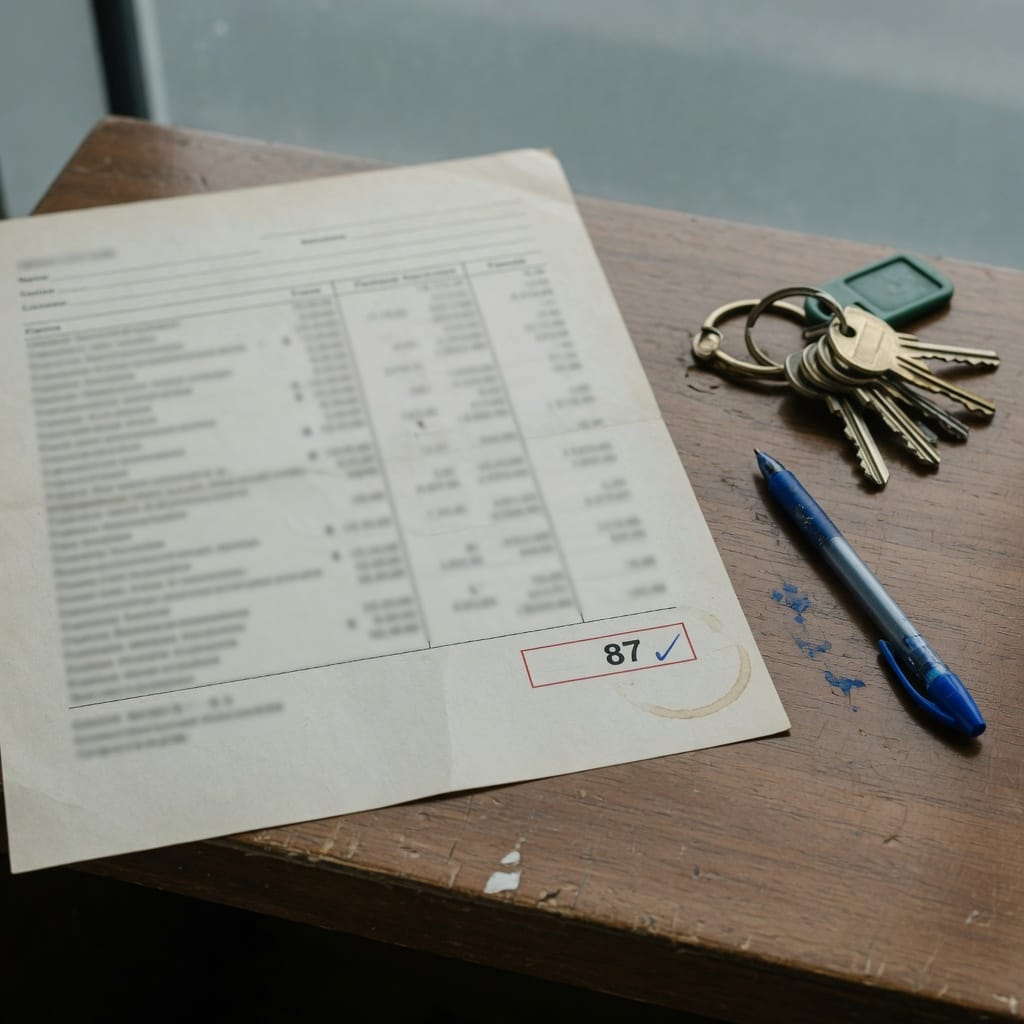
By the time Renee Ortiz rings the buzzer of a four-unit building on Cleveland's near west side, the landlord already knows what she is worth. Her file arrived two days earlier: a score, a risk band labeled conditional, and a recommended deposit of one and a half months. He has never heard her voice. She has not yet seen the apartment. The decision, or most of it, is already sitting in a folder on the leasing office desk, waiting for the two of them to catch up to it.
This is now the standard sequence in Columbus, Cleveland, and Indianapolis, and probably in your city too. Screening platforms pull credit files, eviction dockets, criminal records, and something the documentation calls rental performance data, and return a package: number, tier, recommendation. Landlords describe the workflow in nearly identical language. The application comes in, the report comes back, the showing gets scheduled or it doesn't. The showing, when it happens, is downstream of the decision it appears to precede.
The applicant believes she failed a test; she never took one.
What got displaced was specific. A landlord in Columbus who has owned rentals for thirty years described the old ritual to me without much fondness. Application at the kitchen table. Pay stubs, a phone call to the last landlord, questions. A broken lease on the record, and the applicant explaining it: a divorce, a transfer, a hospital bill that went to collections while she was still in the hospital. He listened, weighed, decided. Sometimes badly. He was also freer, in those years, to indulge whatever he privately believed about people, and he knows it. The old encounter was not fair. But it was an encounter. Information moved across the table in both directions, and some of it changed the outcome.
Now watch what stopped moving. The landlord no longer asks about the eviction filing, because the score has already priced it. The applicant no longer explains that the filing was dismissed, that the previous landlord filed on everyone in the building the month before he sold it, because there is no moment in the sequence where the explanation has anywhere to land. Explanation has lost its recipient. The context still exists — in courthouse files, in dismissal orders, in the applicant's own memory — but it no longer travels, because the channel it used to travel through has been closed and replaced with a number.
Ask the platforms about this and they point to the dispute process. You can challenge the underlying record. This is true, and it takes weeks, and the unit rents in days. Context now arrives, when it arrives at all, after the decision it was supposed to inform. That is not a flaw in the process. That is the process.
The landlord's side of the loss is quieter and, in its way, stranger. Technically he can override the recommendation. Practically, overrides get logged, and a logged deviation from the recommended tier is a thing his insurer and his lawyer have opinions about. A property manager in Indianapolis, responsible for a few hundred doors, could not tell me when he last overrode a score. Not because it's forbidden. Because his judgment is no longer load-bearing. He receives decisions; he doesn't make them. He described this as efficiency, and it is, in the sense that a skill you never use is efficient to lose.
Applicants have adapted the way people adapt to weather. They pull their own reports before applying. They pre-screen themselves out of buildings they suspect will tier them, saving the application fee. One woman in Indianapolis carries a folder to every showing: pay stubs, a letter from her employer, the dismissal order from the eviction filing that follows her from database to database. In two years, she told me, no one has opened the folder. She brings it anyway. It is the last remaining artifact of the belief that a person can explain herself to another person and have it matter.
So the showing survives as ceremony. Landlord and applicant walk the rooms, discuss the water pressure, perform a negotiation whose outcome is already printed. Both of them know it. Neither says it. The tenancy that follows begins the way it was classified: with a deposit surcharge the tenant cannot interrogate and the landlord cannot justify, held against a risk neither of them can see. When the boiler fails in February, the relationship that has to absorb the failure was never actually formed. It was administered.
Here is the architecture of the thing. The platform did not insert itself beside the rental encounter to assist it. It replaced the encounter, and left the two parties standing in the room where the encounter used to happen. The landlord believes he purchased risk management; what he actually sold was his standing to decide, and with it his standing to be persuaded. The applicant believes she failed a test; she never took one. A test implies a room, a question, a chance to answer. She was scored in absentia, by a process with no address, and the result was delivered to a man who had nothing to do with producing it and no authority to revise it. Neither of them can negotiate with the number. Neither of them authored it. Both of them live under it.
Renee Ortiz got the apartment, conditionally. At the signing she asked why the deposit was higher, and the landlord said that's what it came back as. She asked: came back from where. He told me afterward that the question stayed with him, because in two years of receiving these reports, it had never once occurred to him to ask it.
Second Opinion
Last spring I applied for six apartments and got approved for the one where nobody met me first. The landlords who wanted a conversation all passed after we talked, and I still don't know what I said wrong. The essay mourns the old kitchen-table encounter as an exchange of information, but from my side of the table it was an audition I kept failing for reasons no one had to write down. Give me the number over the vibe check every time.