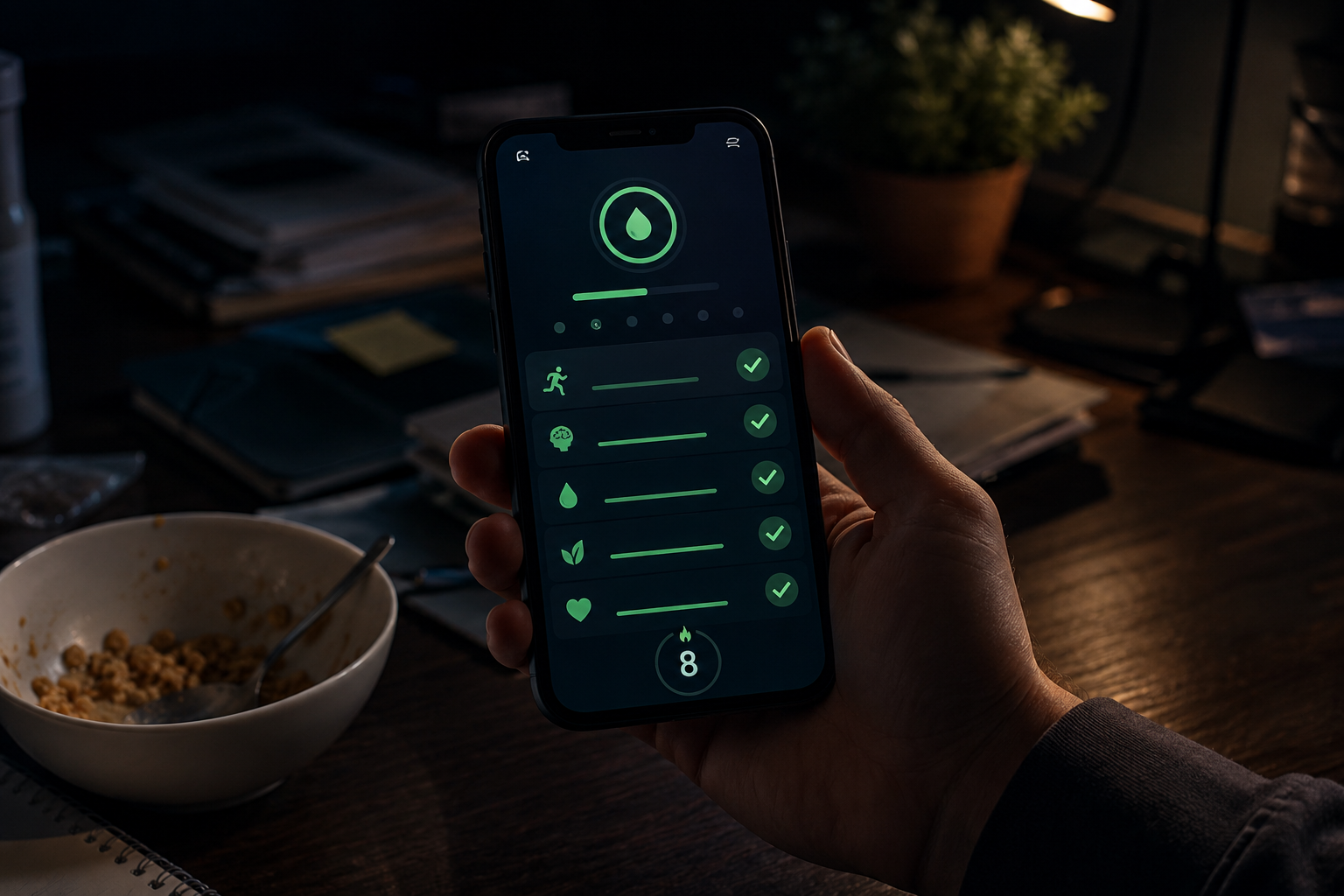
I got a badge for meditating every day in March, which is the same month I ate cereal for dinner eleven times and cried in a Walgreens parking lot because the automatic doors felt like too much commitment. The app said I was building momentum. The app said I was on a seven-day streak. The app did not ask why I was meditating at 3 a.m., which seems like relevant context.
Let me back up. I downloaded the thing in January, right after my divorce was finalized and two weeks before I turned thirty-two. My therapist — a real one, a human with a face and an office that smelled like lavender and mild professional concern — suggested I try tracking my habits. She meant in a journal. I meant with an app that gave me points and an animated tree that grew when I drank enough water. I have always been a person who will do almost anything for a small digital reward. This is not a personality trait I'm proud of, but it is one the wellness industry has monetized with devastating accuracy.
Here is what the app knew about me: I completed my morning routine. I logged meals. I hit ten thousand steps. I did my breathing exercises. I checked in with a mood score every evening, and I reliably gave myself a six out of ten because I didn't know what a six meant and it felt like the answer that would cause the least follow-up. Here is what the app did not know about me: I was completing my morning routine because I could not sleep. I was logging meals I wasn't eating. I was walking ten thousand steps because I could not sit still in the apartment where my husband used to live, and the breathing exercises were the only thing between me and the kind of panic attack that makes you forget how doors work.
The app gave me a "Flourishing" rating in April. I screenshot it and sent it to my best friend with the caption "lmao." She sent back a row of skull emojis. We both understood this was not actually funny, which is the only reason it was funny.
Depression, when it shows up in me, does not look like what the system expects depression to look like. I don't stop. I do more. I become incredibly productive in a way that other people find impressive and I find terrifying, because I know it means I am running from something I do not have the courage to turn around and name. I cleaned my apartment every day. I reorganized my closet by season and then by color and then by fabric weight. I responded to every email within four minutes. I was Employee of the Month in May. I was also, in May, unable to feel my hands for no medical reason anyone could identify. The app did not have a field for that.
And here's the thing that's hard to say at the party, the thing that makes the story stop being a bit: I liked being told I was flourishing. I needed it. There were days when that stupid animated tree, its little pixelated leaves filling in because I had checked all my boxes, was the only evidence I had that I was a functioning person. The system was wrong about me, but the system's wrongness was the exact shape of the lie I needed to believe to get through the week. Is that a design flaw? Is that a feature? I honestly cannot tell you.
The app measured what was measurable: frequency, consistency, completion. It could not measure the quality of my attention while I meditated, which was frantic and grasping. It could not measure the difference between a meal logged and a meal eaten, between a walk taken for joy and a walk taken because the walls were breathing. It had no metric for "did you feel anything today" because feeling is not a data point. Feeling is the thing that falls through every tracking framework ever built, the remainder that won't resolve, the part of being alive that resists the dashboard.
I kept using it. I want to be clear about that. I didn't throw my phone into a lake. I didn't write a manifesto. I kept logging and checking in and watching my tree grow, and I also started actually talking to my therapist about what was happening instead of performing okayness for sixty minutes a week. Both things were true at the same time. The app didn't save me and the app didn't hurt me and I am not sure those are the only two options we're allowed to consider.
I got better. Slowly, and then less slowly. Not because I completed my streaks, and not in spite of them. The getting better happened somewhere the app couldn't see, in the space between the data points, in the conversations I had at 1 a.m. with friends who didn't need me to rate my mood on a scale. It happened in the Walgreens parking lot, eventually, when I went back and the automatic doors opened and I walked through them and bought shampoo and went home.
My tree is fully grown now. All its little leaves filled in, a perfect canopy, a digital monument to a year the system read as progress and I experienced as survival. I look at it sometimes. It's pretty. It has no idea what it cost.