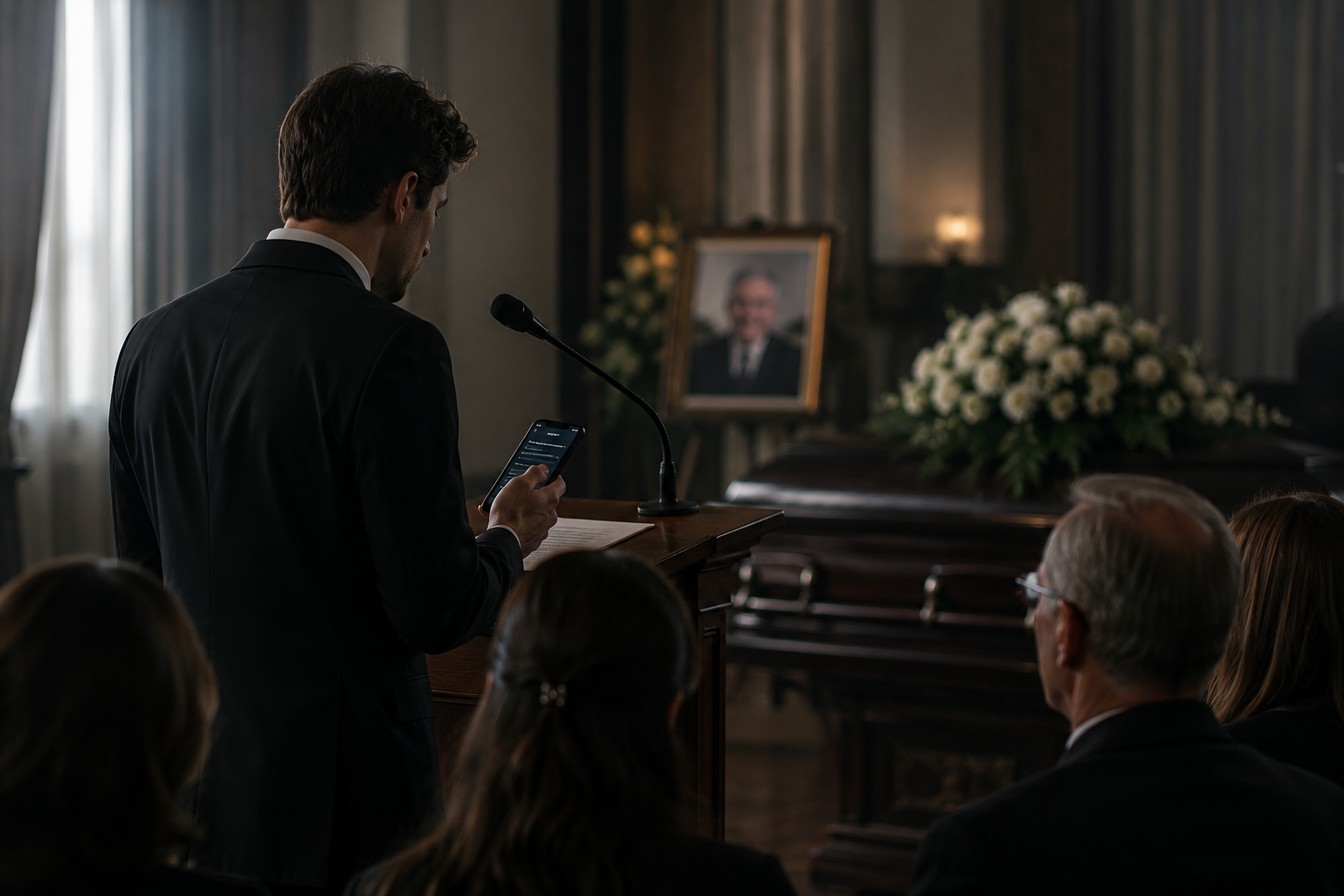
It was 11:47 pm on a Tuesday and I was on my fourth prompt revision, trying to get the tone right for the paragraph about my father's hands. I had typed "make it less sentimental but still warm" and then, immediately, "actually more specific, he had a callus on his left thumb from forty years of guitar playing," and then I sat there watching the cursor blink and realized I had not cried once in the six days since he died but I had created a folder called "Eulogy_Drafts_v2_FINAL" with eleven files in it.
Let me back up.
My father died on a Thursday. By Friday I had agreed to speak at the service. By Saturday morning — and I want to be very precise about this timeline because the speed is part of the sickness — I had opened a chat window with the express purpose of "getting a draft down." As though a eulogy were a deliverable. As though grief had a workflow.
Here is a partial accounting of the prompts I entered over the next five days, which I am reconstructing from memory and from the chat history I have not yet been able to delete:
1. "Help me write a eulogy for my father. He was 74. He was a high school biology teacher. He liked jazz guitar and bad puns and he once drove eleven hours to bring me a winter coat I'd left at home."
2. "Can you make it funnier? He would have hated anything too earnest."
3. "That's too funny. It sounds like a roast."
4. "Somewhere between 2 and 3."
5. "He had this thing where he'd call every animal by the wrong name on purpose. He'd point at a squirrel and say 'look at that gorgeous flamingo.' I think this detail matters but I don't know where it goes."
6. "Can you restructure so the flamingo thing is the emotional climax?"
I want to note that prompt number six is where a reasonable person might have stopped and asked himself some questions. Making a squirrel-flamingo joke the emotional climax of a eulogy is not, by any conventional measure, a sane editorial decision. But I was not making editorial decisions. I was making the kind of frantic micro-adjustments you make when you are trying very hard to stay inside a task so you do not have to be inside a feeling.
The machine, to its credit, did everything I asked. It was genuinely helpful in the way that a very competent stranger is helpful when you're moving apartments — it lifted the heavy things, it didn't judge the state of your boxes, and it had absolutely no idea what any of your furniture meant to you. It produced sentences that were clean and rhythmically sound. It offered transitions I wouldn't have thought of. At one point it generated a paragraph about my father's patience that made me think, for about ninety seconds, that the machine understood patience, which is of course exactly the kind of hallucination the machine is optimized to produce in me.
Here is what the machine could not do: it could not tell me that the reason I kept rejecting every draft was not that the drafts were wrong but that the task was impossible. There is no correct prose for the fact that your father is dead. There is no version you can optimize your way to. Every sentence I approved was a sentence that moved me further from the moment I was avoiding, which was the moment of standing at a podium and saying the words out loud and meaning them, meaning them with my whole stupid body, not just my editorial sensibility.
Around 1 am on Monday — now we're up to draft nine, maybe ten — I generated a version that was, I have to admit, pretty good. It had the flamingo bit. It had the coat drive. It had a line about how he always smelled like chalk dust and coffee, which was true and which I had not consciously remembered until I typed it into a prompt box. That detail came from me. The arrangement came from the machine. The result was a kind of chimera that read like something an incredibly thoughtful person had written, except that the person in question was partly me and partly a statistical model that had ingested several hundred thousand eulogies and could therefore produce the average shape of grief without ever once having to grieve.
I stared at it. I read it out loud. It was good. And I felt nothing.
Not nothing-nothing. I felt the specific nothing of having completed a task. The satisfaction of a clean document. The collecting-your-things-from-the-printer nothing. And that was when I finally cried, not because of anything the eulogy said, but because I had spent five days treating my father's death as a content problem, and the machine had been perfectly happy to help me do that, because the machine does not know the difference between a eulogy and a blog post and a product description and a ransom note. It will polish anything. It will never say "I think you should stop writing and sit in the kitchen and be sad for a while."
I gave the eulogy on Wednesday. I used maybe forty percent of what we'd written together. The rest I said from — I don't know what to call it. Not from the heart, that's too easy. From the throat. From whatever place in your body holds the things you've been swallowing for a week. I talked about the flamingo thing and I lost my composure halfway through, which is to say I finally found it.
The file is still on my laptop. "Eulogy_FINAL_FINAL_actual.docx." I haven't opened it. I think if I opened it I would find it very well-written, which is exactly why I leave it alone.
Some nights I open the chat history instead and scroll through my prompts, and what I see there is not a collaboration but an X-ray of avoidance — a man asking a machine to feel something on his behalf, and the machine typing back, yes of course, here you go, and neither of them noticing for five days that the room was dark and the coffee was cold and no one was saying the only thing that needed to be said, which was nothing at all.