Editor's Note
A luthier in Asheville has been repairing instruments for thirty years. Last spring, an AI diagnostic and repair-sequencing tool arrived in her shop — recommended by her supplier, adopted without ceremony. She is faster now. The question this issue keeps returning to is not whether the repairs are better but what repair ever was: a practice built on the specific intimacy of a broken thing held in human hands, the particular knowledge of failure, and whether that intimacy was always doing something beyond fixing.
In This Issue
The Crack Finder
A first-person account from a luthier of thirty years working through her first full season with an AI structural-diagnostic tool. The essay does not argue against the tool — it is accurate and she knows it — but tracks what her hands have started doing differently when the answer is already on the screen, and whether the thing she is losing has a name she can give it.
Parts Availability
A reported argument examining how AI parts-sourcing platforms have quietly reorganized the supply chain for independent repair contractors in ways that function as an informal credentialing barrier. Draws on supplier agreements, platform documentation, and interviews with six contractors in Virginia and Maryland. The question is not whether the platforms improve logistics — they do — but who the improved logistics are for.
Held
A reported personal account following two debt counselors at a Philadelphia nonprofit through six months of working alongside an AI triage tool. The essay sits with genuine ambivalence: the tool has helped clients reach settlements faster and in greater numbers, and something in the room has changed. Not dramatized. Not resolved.
Faster
A reported affirmative case for an AI repair-coordination platform serving low-income homeowners in New Orleans, built through three years of documented outcomes and participant accounts. The essay makes its case plainly and holds it. The people it describes are specific, and what the platform made possible for them is real.
The Crack Finder
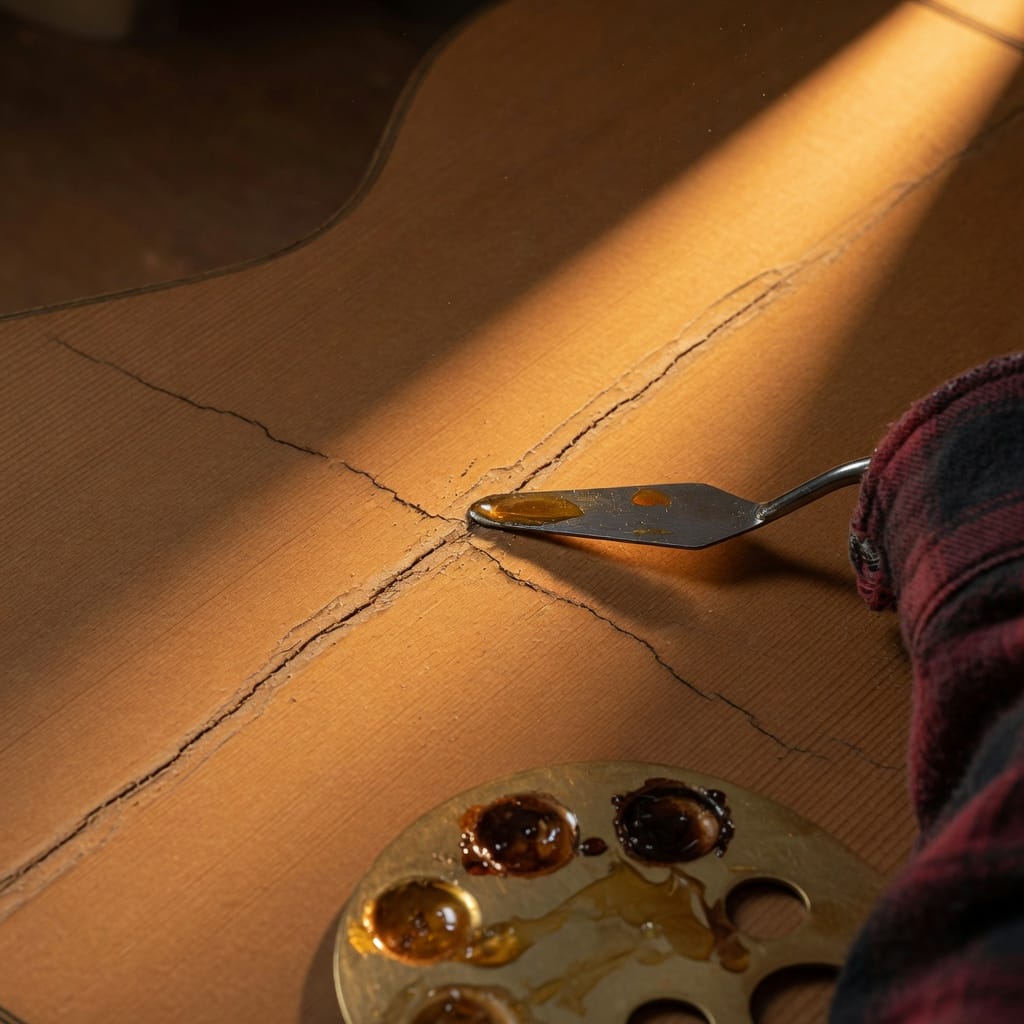
Hide glue keeps for about three days. You mix the granules with water the night before, warm the pot in the morning, and by Thursday it smells wrong and goes down the drain whether you used it or not. I start the day with the pot because it is the one procedure in this shop that has not changed since 1995, and lately I have been keeping count of those.
On the bench this week: a mahogany flattop from the mid-sixties, Adirondack top gone amber under the lacquer, a crack running back from the bridge along the grain. The owner's father bought it new. It spent a winter too close to a woodstove, which is the biography of most cracks in this county.
So the tapping became confirmation, then ritual, then something I had to remind myself to do, and a ritual you have to remind yourself to do is already a memorial.
The scanner sits on a cart beside the bench — a camera arm and a small transducer puck that rests on the lower bout. Before I had the guitar off its blanket, the screen had the whole case mapped: the crack, its length, two loose cleats from a repair somebody did decades ago, and a back brace separating at the kerfing on the treble side. The brace I had not found yet. The machine was right. It is almost always right, which is the part nobody warns you about.
Here is how it used to go. Lamp, inspection mirror, and the knock. Knuckle just behind the bridge, then working out along the lower bout, listening. A sound brace rings. A loose brace clicks, dry, like a latch not quite caught. A seam separation thuds. A crack hiding under finish you find by raking light across the top at a low angle, and by dragging the pad of your thumb across the grain until something catches — a snag you feel before you ever see it. Thirty years of this builds something in a person. I used to think it built skill. Now I think it built a kind of attention that had nowhere else to live.
The tool arrived last spring, recommended by my supplier, in the same shipment as fret wire and a gross of bridge pins. No ceremony. I plugged it in because the rep said it would pay for itself, and because I am sixty-one and my hearing is not what it was up high, which is exactly where loose braces like to hide. Both things turned out to be true.
What has changed is the order of things. The answer now arrives before the instrument does, in effect. I used to pick up a guitar the way you pick up anything that might be hurt — both hands, weight spread, already reading. Palm flat on the top, feeling for the hump of a lifting bridge plate. Nose at the soundhole, because the inside of an old guitar smells like the house it lived in: cedar closet, cigarette, dog. None of that was ever on the work order, and none of it was wasted. Now I catch my hands going straight to the repair. Clamp here, glue there, the sequence laid out on the screen like a recipe. The guitar has become the site of the problem rather than the thing I was asking.
For a while I did both. Scanned, then tapped anyway, checking its work. It never needed checking. So the tapping became confirmation, then ritual, then something I had to remind myself to do, and a ritual you have to remind yourself to do is already a memorial.
I have spent the season trying to name what is going out of the work. Intimacy is too warm a word for what it was. Mostly it was suspicion. You held a broken thing and interrogated it, and the interrogation required you to learn its whole life — where the case buckle struck, who sanded through the finish in 1983, why the third fret is worn only on the bass side. A cowboy-chord player. They always are. The repair at the end was nearly a formality. The knowing was the job; the fixing was how you proved you knew.
The tool knows differently. It knows the crack without the woodstove, the brace without the winter. It is a better finder than I ever was, and finding, I am discovering, was maybe a third of what those taps were actually doing. The other two-thirds I was apparently doing for free, and things you do for free are the first things to go when the work gets efficient.
To be fair to the machine, my cleats are still split from the same billet of spruce I have always used. The glue is still hide, because hide glue releases with heat, and whoever repairs this guitar in another forty years will thank me. Whoever, or whatever. I enjoy that thought more some days than others.
Dana comes in on Saturdays. Nineteen, good hands, patient with a scraper. I make her tap the top and tell me what she hears before I turn the scanner on, and she does it the way you answer a quiz when the answer key is humming on a cart behind you. She is not wrong to. I don't know how to teach the knock as anything but a slow road to an answer she already has. When I learned it, the knock was the only door in. Now it is a door standing next to an open wall, and I am asking her to use the door on principle.
Meanwhile the glue pot needs scrubbing, I am low on cleat stock, and there are three cracks ahead of this one in the queue. Also a mandolin that has been in the corner since August. The scanner says the mandolin needs a new top. I keep putting off tapping it, because I believe it only needs a brace reglued, and one of us is going to be wrong about that in front of the kid.