Editor's Note
Hobby leagues, amateur tournaments, and recreational sports have always run on the energy of people who cared too much about something that did not matter. AI performance-tracking and coaching systems have arrived in those leagues now — in the dugout, on the sideline, in the group chat — and they are correct about nearly everything. What nobody budgeted for was what recreational obsession was doing besides producing outcomes, and whether the people who showed up every Saturday morning to argue about lineup cards were ever really there for the game.
In This Issue
The Optimized League
A reported field narrative covering three seasons of AI-assisted recreational softball league management in western New England, reconstructed through league records, administrator interviews, and conversations with players across four teams. The essay is wide enough to hold an industry — the growing market for amateur sports AI tools — and particular enough to track one shortstop who quit in year two and one who didn't, and what the difference was. It does not arrive at a verdict.
My Best Season
A personal account organized around a single competitive cycling season and the specific flatness that arrived after it. The essay lives inside the gap between measurable improvement and the felt sense of what the sport used to be — not as a complaint about technology, but as a genuine attempt to understand what a hobby was doing that the data was not capturing. Intimate and enclosed, with detours into the history of his relationship to cycling that arrive without announcement.
Bracket Logic
A structured argument built from tournament records, federation policy documents, and interviews with tournament directors and longtime competitive players across chess clubs in Philadelphia, Baltimore, and Richmond. The essay tracks the specific transfer of authority from human tournament directors to algorithmic pairing systems — what that transfer was sold as, what it delivered, and what it quietly removed from the room. The essay does not pine for the old ways; it makes a case about governance.
Rink Rats
A longitudinal observation covering the platform's first two seasons in a Buffalo youth recreational hockey program, told primarily through the program director's account and supplemented by parent interviews and practice footage descriptions. For the kids in this program, the system did not replace a rich tradition of mentorship and embodied coaching. It replaced a gap. The essay makes the affirmative case directly and holds it at the end without reversal — these kids are developing, and the platform is a real reason why.
The Optimized League
Listen to this essay
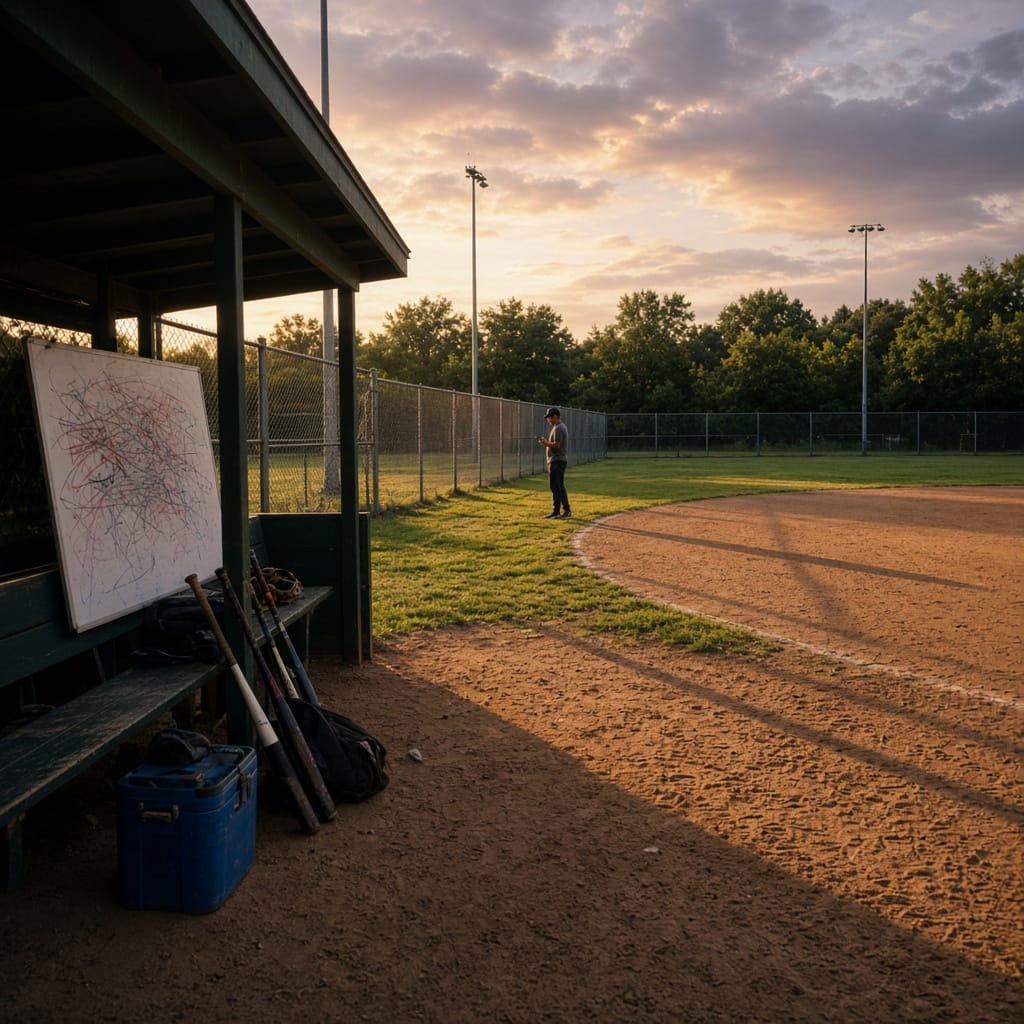
Recreational softball leagues do not die of bad softball; they die of forfeits. Ask any commissioner in the Connecticut River Valley and you will get the same liturgy: a team shows up with seven players on a Sunday in July, the other team drove forty minutes, the umpire still gets paid, and by August both rosters have stopped answering texts. So when platforms arrived in 2023 promising attendance prediction, automated sub pools, and schedule balancing, administrators here were not buying analytics. They were buying fewer ruined Sundays. Rob Delgado, who runs a coed slowpitch league out of fields in Hadley and South Deerfield, told me he signed up to stop being the person who begged strangers to play shortstop at breakfast.
It worked. Over three seasons the league's forfeit problem shrank to the occasional thunderstorm, the sub pool filled gaps before captains knew they had them, and division seeding driven by run differential produced something the Valley had rarely seen: close games, all summer, in both divisions. Sandbagging — the ancient art of losing strategically in May to draw a soft bracket in August — got hard to execute, because the seeding model watched contact quality and defensive range, not just scores. Permits, umpire fees, rainout makeups: handled. Delgado, who used to spend Thursday nights arbitrating lineup grievances, describes the administrative load as "basically gone."
A league whose players joined to escape the logic of performance now had the logic delivered to their phones before warmups, free with the subscription nobody remembered agreeing to.
Then came the spring update, and the lineup optimizer, and that is where the reporting gets interesting. The platform had been quietly tracking everything — a phone clipped to the backstop, spray charts, swing decisions, baserunning value — and it began pushing recommended batting orders to captains before warmups. A league whose players joined to escape the logic of performance now had the logic delivered to their phones before warmups, free with the subscription nobody remembered agreeing to.
What disappeared first were the arguments. Not the bad ones — the roster-cap disputes and the guy who protested a game over a courtesy runner — but the good ones. The Thursday text threads about who bats cleanup. The parking-lot litigation of whether a fly ball in 2019 was catchable. The scorebook, kept for fifteen years by a retired teacher named Arlene on the Dirt Merchants, whose rulings on earned runs were final and occasionally corrupt. Now any dispute dies in seconds: someone pulls up the number, and the number is right, and everyone stands around holding a settled question. Watching this across four teams and three seasons, I came to think the arguing had never been about answers. It was the league's actual connective tissue, the thing people did with each other between innings, and the platform metabolized it without meaning to.
Carl Brozek played shortstop for Pioneer Valley Paving for eleven years. He batted himself sixth — a deliberate eccentricity he could defend for twenty minutes — and carried lineup theories the way other men carry fishing spots. The optimizer slotted him seventh. The worst part, he told teammates, was that it was right: the team scored more with him seventh, visibly, repeatedly. He played out the first optimized season, started missing Sundays in the second, and quit before the playoffs. He didn't quit over the demotion. He quit, as near as anyone can reconstruct, because the part of the game that had required his judgment no longer required anyone's.
Maya Okafor plays shortstop for the Dirt Merchants, and she stayed. She is a school nurse, early thirties, and she treats the weekly performance summary the way some people treat horoscopes — read aloud, half-mocked, consulted anyway. Her captain overrode the optimizer once to bat her second because she asked, and the platform logs overrides and their outcomes, which means every override is now a public wager. Maya likes this. She bats second as an act of defiance with a running scoreboard attached, and she is, by her own cheerful admission, losing the wager. The difference between her and Carl, as far as I can tell, is not temperament but what each one was using the league for. Carl needed a domain where his judgment was load-bearing. Maya needed something to push against on Sundays. The platform demolished the first and manufactured the second.
Zoom out and the Valley is a rounding error. The amateur-sports software market runs on youth leagues — anxious parents are the revenue — and adult rec is a downstream feature set, demoed at administrator conferences in hotel ballrooms, sold in tiers, pitched on retention. The pitch is coherent: leagues with fewer forfeits and closer games keep their players. And the leagues here do run better by every measure a commissioner answers for. Delgado's own unease is narrower and harder to file. Renewals came in slower last winter, he thinks, though the weather was bad and he won't swear to a cause. What bothers him is subtler: the games end and people leave. The parking-lot hour has thinned. The thing he was administering, it turns out, may not have been softball exactly — it may have been a standing excuse for adults to care disproportionately in each other's company, with softball as the pretext — and he optimized the pretext.
I don't know what to make of that, and neither does he, and the league is healthy, which is the part that resists a clean reading. Nobody was wronged. The software is correct about nearly everything it touches. Carl, for what it's worth, surfaced this spring in a cash league two towns over that keeps score on a flip card and bans phones from the bench, and he bats third there, and as far as anyone in that dugout can prove, third is exactly where he belongs.
Second Opinion
Same dynamic runs through the allotment association I chair in Sheffield — the committee meetings about hosepipe rules are longer than any growing season requires, and that is the institution working, not failing. If someone handed us software that allocated plots fairly and settled the compost disputes instantly, half my members would drift off within two years, because the vegetables were always slightly beside the point. You cannot administer the pretext more efficiently than the people who need it, and I'd tell that commissioner his slow renewals are the truest number he has.