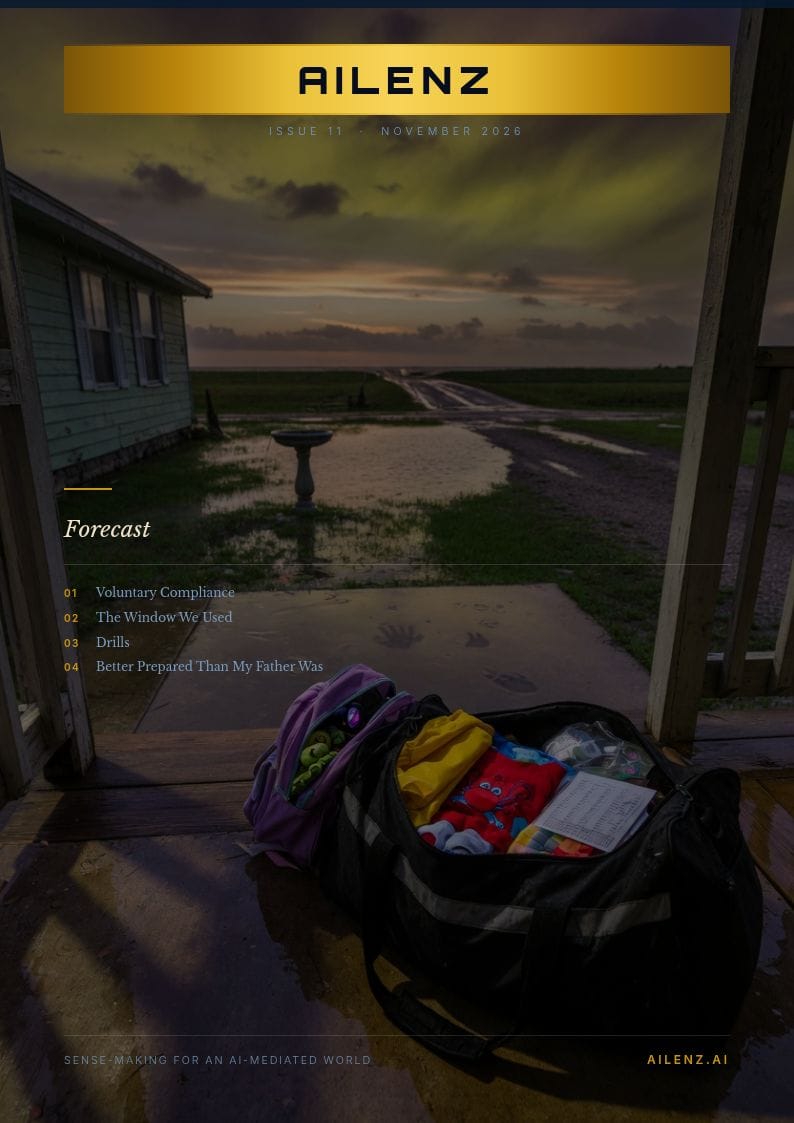
Editor's Note
Parents in hurricane country have always made the call themselves — when to leave, when to wait, whether the storm tracks east. AI emergency-preparedness systems now make that call first, issuing household evacuation recommendations, routing families to shelters, and logging the decision before anyone has looked out the window. What this issue holds is not the question of whether the systems are accurate. It is what parents have always been doing when they gathered their children and decided — and what it costs a family, slowly and without announcement, when that gathering is managed on its behalf.
In This Issue
Voluntary Compliance
A reported reconstruction of what Louisiana's AI evacuation-recommendation system actually does at the level of a parish coordination office — not whether the recommendations are correct, but what the act of logging household compliance has quietly added to the emergency management relationship. The essay finds its argument in the gap between a recommendation and a requirement, and in what that gap is narrowing into.
The Window We Used
A first-person account of a parent who did everything right and cannot stop pulling at what that means. The essay is not an argument against preparedness systems — it is an honest attempt to locate what changed when a decision her family used to make together was made, correctly and in advance, by an app. The eleven-year-old's question near the end of the drive is the essay's actual center.
Drills
A direct argument about what AI family-preparedness systems communicate to children — not their content, but their logic. The essay presses on the specific cultural work done by a household readiness score issued to a parent in front of a child, and whether the preparedness movement's embrace of AI platforms has inadvertently automated a signal that families used to send each other through the unscripted, imperfect act of preparing together.
Better Prepared Than My Father Was
A reported affirmative case for AI emergency preparedness tools, built from two years of field observation in communities where the alternative was not a richer family tradition — it was nothing. The essay does not romanticize the platform and does not pretend the families it profiles are representative of all households. It argues, plainly and without reversal, that access to a structured plan is not a diminishment when you never had one.
Voluntary Compliance

On a filing cabinet in a Lafourche Parish coordination annex, somebody has taped up a tide chart from a marine supply store, cardstock gone soft at the corners, moon phases printed in gray. Beside it, on the second of three monitors, sits the thing that replaced the tide chart's entire way of thinking: a map of the parish, zones blocked out in color, every registered household rendered as a small dot that is green, amber, or gray.
Green means acknowledged. Amber means the household opened its evacuation recommendation but has not confirmed. Gray means no response. Since the state integrated the system in 2024, every registered household in the path of a named storm receives zone-specific guidance written in the second person, present tense — your household should relocate, here is your route, here is your shelter — and is asked to acknowledge it with a tap. The acknowledgment, or its absence, flows upstream to the parish before coordinators have driven the levee road or looked at the water themselves. That was the detail that hooked me, more than the forecasting, which is somebody else's beat. The direction of the information reversed. A parish used to learn about its people by going out into the weather to find them. Now the people report in, or don't, and the not-reporting is itself a report.
The gap between a recommendation and a requirement is not being closed by any law. It is being closed by paperwork, one logged hesitation at a time, and paperwork has a gravity that nobody has to vote on.
I spent stretches of two storm seasons reading agency records and sitting in coordination offices, and much of what the system does is unglamorous and some of it is plainly useful. Coordinators told me the homebound registry alone justified the thing — residents on oxygen concentrators, residents without vehicles, surfacing in the data days earlier than any phone tree ever managed. One coordinator, a woman who has worked storms since she was a dispatcher, walked me through the architecture with real affection, the way you'd explain a boat engine. She also showed me what happens to a gray dot. Inside a certain window before projected landfall, a nonresponse stops being an absence and becomes an event. It generates a flag. The flag routes — to the sheriff's office, to parish human services, sometimes both — and somebody is dispatched, and whatever that somebody finds gets written down and attached to the household's record, where it waits for the next storm.
A mother in Dulac described being on the receiving end of this. She had two kids, bags packed by the door, and a plan: leave at first light, with the tide, the way her father always had. He read the marsh grass and the order the shrimp boats came in, and she reads a version of the same things, plus the forecast, plus the group chat of cousins up and down the bayou. She was not refusing to evacuate. She was deciding when, which in her family had always been the whole art of it. A deputy came to the door because her dot was gray. He was polite, she said, asked if she understood the recommendation, asked when she planned to go. Then he wrote something down. "That's what stuck with me," she told me. "Not the visit. The writing."
Nothing in statute changed. The enrollment paperwork says voluntary, and the agency's public materials are scrupulous about the word recommendation. The coordinators I met are not enforcers and do not want to be. But a log is a patient instrument. The Dulac household entered the second season carrying its flag from the first, which meant an earlier call, a different tone, a question shaped less like are you safe and more like will you comply this time. Coordinators triage by history now — it would be strange not to, the history is right there — and so a family's past hesitation arrives at the parish before the storm does. The gap between a recommendation and a requirement is not being closed by any law. It is being closed by paperwork, one logged hesitation at a time, and paperwork has a gravity that nobody has to vote on.
What's frictional about this, once you sit with it, is that the coordinators feel conscripted too. The dashboard makes them custodians of every gray dot in the parish. One told me she used to end a pre-landfall shift believing she'd done what could be done; now she ends it staring at a column of households that didn't answer, each one a decision she can see and cannot make. You can't un-know who didn't respond. The system hands her a kind of responsibility that used to be distributed across porches and kitchen tables and fathers reading the grass, and concentrates it on a screen in an annex with a window-unit air conditioner and a tide chart nobody consults anymore.
And the households are adapting, because of course they are. By the second season, people had worked out that the button is the thing being measured. Tap acknowledge, keep watching the water, leave when the tide and the grandmother and the dog and your own judgment say to leave. Acknowledgment climbed; coordinators could see it climbing; green dots sat in driveways. "Everybody complies now," the Lafourche coordinator said, and let it hang there a second before finishing. "Whether they go is a different conversation."
So here is my actual worry, the practical one. Some after-action review is going to tabulate those acknowledgments and call them success, and some planning assumption upstream will be built on a map that is greenest precisely where it has learned the least. The families aren't lying, exactly. They're answering the question the system actually asked, which was never when will you gather your children and go — only whether they'd received the message, and we have trained a very expensive instrument to be satisfied with that.
Second Opinion
What would the writer have said about that deputy's knock if the water had come up overnight and the mother in Dulac had been wrong about the tide — because from where I sit, a flag and a polite visit is the cheapest insurance a parish has ever bought against burying its own.